93 Percent Stardust by Nikita Gill
(After Carl Sagan, who gave me hope as a child)
We have calcium in our bones,
iron in our veins,
carbon in our souls,
and nitrogen in our brains.
93 percent stardust,
with souls made of flames,
we are all just stars
that have people names.

 |
|
 27 years since Carl Sagan died
"When my husband died, because he was so famous and known for not being a believer, many people would come up to me ― it still sometimes happens ― and ask me if Carl changed at the end and converted to a belief in an afterlife.
They also frequently ask me if I think I will see him again. Carl faced his death with unflagging courage and never sought refuge in illusions. The tragedy was that we knew we would never see each other again. I don't ever expect to be reunited with Carl.
But, the great thing is that when we were together, for nearly twenty years, we lived with a vivid appreciation of how brief and precious life is. We never trivialized the meaning of death by pretending it was anything other than a final parting.
Every single moment that we were alive and we were together was miraculous-not miraculous in the sense of inexplicable or supernatural. We knew we were beneficiaries of chance.
That pure chance could be so generous and so kind. That we could find each other, as Carl wrote so beautifully in Cosmos, you know, in the vastness of space and the immensity of time. That we could be together for twenty years. That is something which sustains me and it’s much more meaningful.
The way he treated me and the way I treated him, the way we took care of each other and our family, while he lived. That is so much more important than the idea I will see him someday. I don't think I'll ever see Carl again. But I saw him. We saw each other. We found each other in the cosmos, and that was wonderful."
― Ann Druyan
|
 Contact (1997) - 5/5 Stars
The universe is a pretty big place. If it's just us, seems like an awful waste of space.
I love this movie. It's truly fantastic and nails the hopeful dream of science, and the headwinds it faces at every step of the way. I apparently hadn't spoken of my love of this movie to Katie before, but I would consider this movie among my top 10 science fiction films of all time, possibly higher.
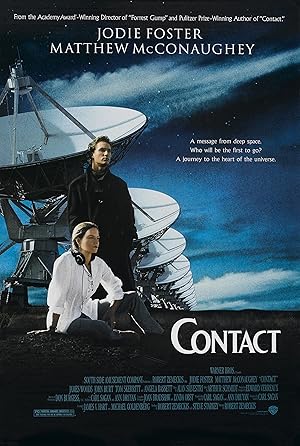
Of course the movie is based on the book written by Carl Sagan. Sagan didn't live long enough to see the movie, but he worked on the film and reportedly did his best to keep it heavily based in science.
|
How the circumference of Earth was calculated by Eratosthenes with sticks
I have seen this clip before but I still love it.
|
Carl Sagan and my mom
So, I had reason to look up about Carl Sagan's death today. And I was surprised to learn two things:
- I had no idea that he had died in Seattle after a bone-marrow transplant at the Fred Hutch Cancer Research Center.
- He died from a disease very similar to the one that my mom had. He died of a myelodisplasia syndrome and the resulting pneumonia. My mother died of myelofibrosis which is a subtype of myelodisplasia.
Two random facts which endear him to me even more.
|
Carl Sagan's Final Speech on Science & Humanity
Here is the episode's complete transcript (more than the segment in the video above, which I have bolded at the end.) I found the transcript here, but am copying it to preserve it in case the site disappears. There is a segment of the clip which was not captured in the copied transcript, I'm not sure what explains this discrepancy, but I have transcribed and inserted it.
…The civilization now in jeopardy is all humanity. As the ancient myth makers knew, we are children equally of the earth and sky. In our tenure of this planet, we have accumulated dangerous, evolutionary baggage -- propensities for aggression and ritual, submission to leaders, hostility to outsiders, all of which puts our survival in some doubt. We have also acquired compassion for others, love for our children, a desire to learn from history and experience, and a great, soaring passionate intelligence -- the clear tools for our continued survival and prosperity.
Which aspects of our nature will prevail is uncertain, particularly when our visions and prospects are bound to one small part of the small planet earth. But, up and in the cosmos an inescapable perspective awaits. National boundaries are not evidenced when we view the earth from space. Fanatic ethnic or religious or national identifications are a little difficult to support when we see our planet as a fragile, blue crescent fading to become an inconspicuous point of light against the bastion and citadel of the stars.
There are not yet obvious signs of extraterrestrial intelligence, and this makes us wonder whether civilizations like ours rush inevitably into self-destruction. I dream about it . . . and sometimes they are bad dreams.
In the vision of the dream I once imagined myself searching for other civilizations in the cosmos. Among a hundred billion galaxies and a billion trillion stars, life and intelligence should have arisen in many worlds; some worlds are barren and desolate. On them life never began or may have been extinguished in some cosmic catastrophe. There may be worlds rich in life not yet evolved to intelligence and high technology; there may be civilizations that achieved technology and then promptly used it to destroy themselves; and, perhaps, there are also beings who learn to live with their technology and themselves, beings who endure and become citizens of the cosmos.
Immersed in these thoughts, I found myself approaching a world that was clearly inhabited, a world I had visited before. I saw a planet encompassed by light and recognized the signature of intelligence. But, suddenly, darkness -- total and absolute.
In my dream, I could read the "Book of Worlds", a vast encyclopedia of a billion planets within the Milky Way. What could the galactic computer tell me about this now darkened world? They must have survived some earlier catastrophe. Their biology was different from ours. High technology. I wondered what those lights had been for; there must have been signs they were in trouble. The possibility of survival in a century -- less than one percent, not very good odds. Communications interrupted. Their world society had failed; they had made the ultimate mistake. I felt a longing to return to earth.
The television transmissions from earth rushed past me, expanding away from our planet at the speed of light. Then suddenly -- silence, total and absolute. But the dream was not yet done.
Had we destroyed our home? What had we done to the earth? There had been many ways for life to perish at our hands; we had poisoned the air and water; we had ravaged the land. Perhaps we had changed the climate. Could it have been a plague or nuclear war? I remembered the galactic computer. What would it say about the earth?
There was our region of the galaxy; there was our world. I had found the entry for earth: HUMANITY: THIRD FROM THE SUN. They had heard our television broadcasts and thought them an application for cosmic citizenship. Our technology had been growing enormously (they got that right). Two hundred nation states, about six global powers, the potential to become one planet. Probability of survival over a century -- here, also, less than one percent. So, it was nuclear war, a full nuclear exchange.
There would be no more big questions, no more answers. Never again a love or a child; no descendents to remember us and be proud; no more voyages to the stars, no more songs from the earth.
I saw east Africa and thought, "a few million years ago we humans took our first steps there. Our brains grew and changed. The old parts began to be guided by the new parts, and this made us human -- with compassion and foresight and reason. But, instead, we listened to that reptilian voice within us, counseling fear, territoriality and aggression. We accepted the products of science; we rejected its methods".
Maybe the reptiles will evolve intelligence once more. Perhaps, one day, there will be civilizations again on earth. There will be life, there will be intelligence; but there will be no more humans -- not here, not in a billion worlds.
Every thinking person fears nuclear war, and every technological nation plans for it. Everyone knows its madness, and every country has an excuse. There is a dreary chain of causality. The Germans were working on the bomb at the beginning of World War II, so the Americans had to make one first. If the Americans had one, the Russians had to have one. Then the British, the French, the Chinese, the Indians, the Pakistanis. Many nations now collect nuclear weapons; they are easy to make. You can steal fissionable material from nuclear reactors. Nuclear weapons have almost become a home industry.
The conventional bombs of World War II were called "blockbusters", filled with 20 tons of TNT they could destroy a city block. All the bombs dropped on all the cities during World War II amounted to some 2 million tons of TNT -- two megatons. Coventry, Rotterdam, Dresden and Tokyo -- all the death that rained from the skies between 1939 and 1945 -- a hundred thousand blockbusters, two megatons. Today, two megatons is the equivalent of a single thermonuclear bomb -- one bomb with the destructive force of the second world war. But there are tens of thousands of nuclear weapons. The missile and bomber forces in the Soviet Union and United States have warheads aimed at over 15,000 designated targets. No place on the planet is safe.
The energy contained in these weapons -- genies of death, patiently awaiting the rubbing of the lamps -- totals far more than 10,000 megatons; but, with the destruction concentrated efficiently, not over six years but over a few hours. A blockbuster for every family on the planet; a World War II every second for the length of a lazy afternoon.
The bomb dropped on Hiroshima killed 70,000 people. In a full nuclear exchange, in the paroxysm of global death, the equivalent of a million Hiroshimas would be dropped all over the world. And, in such an exchange not everyone would be killed by the blast and the fire storm and the immediate radiation. There would be other agonies. The loss of loved ones; the legions of the burned and blinded and mutilated; disease; plague; long-lived radiation poisoning the soil and the water; the threat of stillbirths and malformed children; and, the hopeless sense of a civilization destroyed for nothing. The knowledge that we could have prevented it and did nothing.
The global balance of terror pioneered by the United States and the Soviet Union holds hostage all the citizens of the earth. Each side consistently probes the limits of the other's tolerance -- like the Cuban missile crisis, the testing of anti-satellite weapons, the Vietnam and Afghanistan wars. The hostile military establishments are locked in some ghastly mutual embrace, each needs the other but the balance of terror is a delicate balance with very little margin for miscalculation. And the world impoverishes itself by spending half a trillion dollars a year in preparations for war and by employing perhaps half the scientists and high technologists on the planet in military endeavors.
How would we explain all this to a dispassionate, extraterrestrial observer? What account would we give of our stewardship of the planet earth?
We have heard the rationales offered by the superpowers. We know who speaks for the nations; but who speaks for the human species? Who speaks for earth?
From an extraterrestrial perspective, our global civilization is clearly on the edge of failure and the most important task it faces is preserving the lives and well-being of its citizens and the future habitability of the planet. If we are willing to live with the growing likelihood of nuclear war, shouldn't we also be willing to explore vigorously every possible means to prevent nuclear war? Shouldn't we consider in every nation major changes in the traditional ways of doing things, a fundamental restructuring of economic, political, social and religious institutions? We have reached a point where there can be no more special interests or special cases. Nuclear arms threaten every person on the earth.
Fundamental changes in society are sometimes labeled impractical or contrary to human nature: as if nuclear war were practical or as if there were only one human nature. But fundamental changes can clearly be made. We are surrounded by them. In the last two centuries abject slavery, which was with us for thousands of years, has almost entirely been eliminated in a stirring world wide revolution. Women, systematically mistreated for millennia, are gradually gaining the political and economic power traditionally denied to them. And some wars of aggression have recently been stopped or curtailed because of a revulsion felt by the people in the aggressor nations. The old appeals to racial, sexual and religious chauvinism and to rabid nationalism are beginning not to work. A new consciousness is developing which sees the earth as a single organism and recognizes that an organism at war with itself is doomed. We are one planet.
One of the great revelations of the age of space exploration is the image of the earth, finite and lonely, somehow vulnerable, bearing the entire human species through the oceans of space and time. But this is an ancient perception . . . history is full of people who, out of fear or ignorance or the lust for power, have destroyed treasures of immeasurable value which truly belong to all of us. We must not let it happen again.
We have considered the destruction of worlds and the end of civilizations, but there is another perspective by which to measure human endeavors. Let me tell you a story -- about the beginning.
Some fifteen billion years ago our universe began with the mightiest explosion of all time. The universe expanded, cooled and darkened. Energy condensed into matter, mostly hydrogen atoms, and these atoms accumulated into vast clouds; rushing away from each other they would one day become the galaxies. Within these galaxies the first generation of stars was borne, kindling the energy hidden in matter, flooding the cosmos with light. Hydrogen atoms that made suns and starlight. There were in those times no planets to receive the light, no living creatures to admire the radiance of the heavens. But deep in the stellar furnaces nuclear fusion was creating the heavier atoms -- carbon and oxygen, silicon and iron. These elements, the ash left by hydrogen, were the raw materials from which planets and life later arrived.
At first, the heavier elements were trapped in the hearts of the stars, but massive stars soon exhausted their fuel and in their death throes returned most of their substance back into space. Interstellar gas became enriched with heavy elements.
In the Milky Way galaxy the matter of the cosmos was recycled into new generations of stars now rich in heavy atoms, a legacy from their stellar ancestors. And in the cold of. interstellar space great turbulent clouds were gathered. by gravity and stirred by starlight. In the depths the heavy atoms condensed into grains of rocky dust and ice, complex carbon-based molecules. In accordance with the laws of physics and chemistry, hydrogen atoms had brought forth the stuff of life. In other clouds more massive aggregates of gas and dust formed later generations of stars. As new stars were formed, tiny condensations of matter accreted near them, inconspicuous moats of rock and material ice and gas that would become the planets And on these worlds, as in interstellar clouds, organic molecules formed made of atoms that had been cooked inside the stars. In the tide pools and oceans of many worlds molecules were destroyed by sunlight and assembled by chemistry. One day, in these natural experiments, a molecule arose that quite by accident was able to make crude copies of itself.
As time passed self-replication became more accurate as molecules that copied better produced more copies. Natural selection was under way. Elaborate molecular machines had evolved slowly, imperceptibly -- life had begun. Collectives of organic molecules evolved into one-celled organisms. These produced multi-celled colonies. Various parts became specialized organs. Some colonies attached themselves to the sea floor; others swam freely. Eyes evolved and now the cosmos could see. Living things moved on to colonize the land. Reptiles held sway for a time and gave way to small, warm blooded creatures with bigger brains who developed dexterity and curiosity about their environment. They learned to use tools and fire and language -- star stuff, the ash of stellar alchemy had emerged into consciousness.
We are a way for the cosmos to know itself. We are creatures of the cosmos and always hunger to know our origins, to understand our connection with the universe. How did everything come to be? Every culture on the planet has devised its own response to the riddle posed by the universe. Every culture celebrates the cycles of life and nature. There are many different ways of being human.
But, an extraterrestrial visitor examining the differences among human societies would find those differences trivial compared to the similarities. We are one species. We are star stuff harvesting star light. Our lives, our past and our future are tied to the sun, the moon and the stars. Our ancestors knew that their survival depended on understanding the heavens. They built observatories and computers to predict the changing of the seasons by the motions in the skies. We are all of us descended from astronomers.
The discovery that there is order in the universe, that there are laws of nature, is the foundation on which science is built on today. Our conception of the cosmos -- all of modern science and technology --is traced back to questions raised by the stars. Yet, even 400 years ago we had still no idea of our place in the universe. The long journey to that understanding required both an unflinching respect for the facts and a delight in the natural world.
Johannes Kepler wrote: "We do not ask for what useful purpose the birds do sing, for song is their pleasure since they were created for singing. Similarly, we ought not to ask why the human mind troubles to fathom the secrets of the heavens. The diversity of the phenomena of nature is so great and the treasures hidden in the heavens so rich precisely in order that the human mind shall never be lacking in fresh enrichment."
It is the birthright of every child to encounter the cosmos anew in every culture in every age. When this happens to us, we experience a deep sense of wonder. The most fortunate among us are guided by teachers who channel this exhilaration. We are born to delight in the world; we are taught to distinguish our preconceptions from the truth. Then, new worlds are discovered as we decipher the mysteries of the cosmos.
Science is a collective enterprise which embraces many cultures and spans the generations in every age and sometimes in the most unlikely places there are those who wish with a great deal of passion to understand the world. There is no way of knowing where the next discovery will come from. What dream of the mind's eye will remake the world. These dreams begin as impossibilities. Once, even to see a planet through a telescope was an astonishment; but we studied these worlds, figured out how they moved in their orbits, and soon we were planning voyages of discovery beyond the earth and sending robot explorers to the planets and the stars.
We humans long to be connected with our origins so we create rituals. Science is another way to experience this longing. It also connects us with our origins, and it too has its rituals and its commandments. Its only sacred truth is that there are no sacred truths. All assumptions must be critically examined. Arguments from authority are worthless. Whatever is inconsistent with the facts -- no matter how fond of it we are -- must be discarded or revised. Science is not perfect. It is often misused. It is only a tool, but it is the best tool we have -- self-correcting, ever changing, applicable to everything. With this tool we vanquish the impossible; with the methods of science we have begun to explore the cosmos. For the first time scientific discoveries are widely accessible. Our machines -- the products of our science -- are now beyond the orbit of Saturn. A preliminary spacecraft reconnaissance has been made of 20 new worlds. We have learned to value careful observation, to respect the facts even when they are disquieting, when they seem to contradict "conventional wisdom".
The Canterbury monks faithfully recorded an impact on the moon. And the Anasazi people, an explosion of a distant star. They saw for us as we see for them. We see further than they only because we stand on their shoulders. We build on what they knew.
We depend upon free inquiry and free access to knowledge. We humans have seen the atoms which constitute all of nature and the forces that sculpted this work and others. We have found that the molecules of life are easily formed under conditions throughout the cosmos. We have mapped the molecular machines of the heart of life. We have discovered a microcosm in a drop of water; we have peered into the bloodstream and down on the stormy planet to see the earth as a single organism. We have found volcanoes on other worlds and explosions on the sun, studied comets from the depths of space and traced their origins and destinies; listened to pulsars and searched for other civilizations.
We humans have set foot on another world in a place called the Sea of Tranquility, an astonishing achievement for creatures such as we, whose earliest footsteps three and one-half million years old are preserved in the volcanic ash of east Africa. We have walked far.
These are some of the things that hydrogen atoms do given fifteen billion years of cosmic evolution. It has the sound of epic myth, but it is simply a description of the evolution of the cosmos as revealed by science in our time. And we, we who embody the local eyes and ears and thoughts and feelings of the cosmos, we have begun at least to wonder about our origins -- star stuff contemplating the stars, organized collections of ten billion billion billion atoms, contemplating the evolution of nature, tracing that long path by which it arrived at consciousness here on the planet earth, and perhaps throughout the cosmos.
Our loyalties are to the species and to the planet. We speak for earth. Our obligation to survive and flourish is owed not just to ourselves but also to that cosmos ancient and vast from which we spring!
Powerfully moving. What a treasure Carl Sagan was.
|
