I lost most of my afternoon wrestling with the home server. I tried resizing some partitions, and it broke the boot process, which turned into a real ordeal. Thankfully, no data was lost, but it was a frustrating way to spend the day.

 |
|
I am Nostalgic for iPods
I love technology. I have a handful of my defunct eletronics from over the years, from my first Droid phone, and a few between, to my most recent Surface Duo 2. I don't have an iPod. And I should.
I am nostalgic for iPods.
I watched this video of someone customizing / refurbishing an iPod and found myself wanting one. I don't need it. I don't even need it for the purpose of breaking from streaming. We don't pay for streaming music and I have a home Plex server that I can stream our music from.
What I realized is that this is less about the technology item itself. It's not about an iPod. It's about my being nostalgic for the feeling of excitement at the unfolding of new technology. Going from a portable CD player to an iPod felt like jumping to light speed for the technology around us.
|
Wireless Headphone Suffering
I hate when I am trying to solve a tech issue and I try one last thing to confirm it's the hardware, and then the last thing works, which sends me back into the "no there is clearly a setting somewhere I'm missing."
So I have a JLab Hands free headset which has been my go-to for several years. A few months ago something changed on Windows and now it only records static. I've run through the ringer, uninstalling drivers, trying generic drivers, I tried VoiceMeeter as an intermediate device and... still no luck.
I go to put a Logitech headset in my Amazon cart, to threaten the universe with this headset's demise. Then I decide to connect the headset to my phone and see if it works and... to my chagrin - it does. So the JLab headset works, but not with Windows and I can't figure out why.
I head to the company helpdesk this morning and offer them the choice of either trying to triage the issue or give me another set of headphones to use and, unsurprisingly, they opted for the latter. Apparently these sorts of issues are well known for bluetooth headsets and Windows and I had already done the two things they would have suggested we try. So I'm back to using a wired headset for the time being.
It occurs to me, the phone workaround I blogged about last week for hearing audio from the computer through the phone could work here, but it doesn't seem worth the trouble and I'd have to contend with corporate wifi on my phone rather than at my house.
|
"Apple CEO Tim Cook is stepping down, John Ternus set to replace him"
Wow.
Update: Okay, apparently this isn't as unexpected as I thought. I wasn't aware it was somewhat expected.
|
Using my phone as a computer speaker
I am aiming to have a productive day today. I have a to task list and everything. But there are also audio files on my computer I want to listen to and rather than go through the trouble of transferring that file to my phone, I thought it would be cool to be able to pipe my computer's audio over the network to my phone. That way as I move room to room I can stay tuned to the audio.
Enter AudioRelay, a windows freeware, and a free Android app. I installed both and they synced and it works seamlessly.
I don't know how often I'll use it, but in this case it is a good solution for me.
|
But what does progress even mean, if it doesn't include better lives for people who work? What is the point of greater efficiency, if the money being saved isn't going anywhere except into shareholders' bank accounts? We should all strive to be Luddites, because we should all be more concerned with economic justice than with increasing the private accumulation of capital. We need to be able to criticize harmful uses of technology—and those include uses that benefit shareholders over workers—without being described as opponents of technology. - Ted Chiang
|
That feeling when a technology thing breaks in the house, and at first you worry that it's your fault, then discover it isn't your fault but you aren't sure why it happened?
Yeah, that feeling is very mixed
|
The Silverfish of Tomorrow
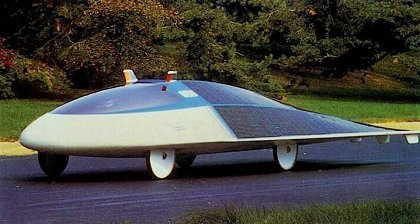
Woke up thinking about one of the futuristic items from my childhood, the Sunraycer, which was a solar powered electric vehicle which showed the promise of the future.
|
 Of Arthur and Pictures
I ended up taking advantage of a Black Friday deal for a new personal laptop. I've been using one I got from Costco for a few years, but there are a few issues with it (predominately relating to the keyboard) which has run fine (mostly) and so with the new job and a deal on Wirecutter's top recommended laptop - it was time.
Enter: Arthur.
I ended up going for a Lenovo Yoga laptop and after a short outing this morning, I've collected it from Best Buy and am back home where it is currently installing updates. I'm writing this via the older laptop, for likely the last entry on the blog from this computer.
Though it likely isn't the end for this machine. Since most of its issues are laptop based, I think it's possible that this laptop gets repurposed as some technology tool in the house.
After the recent family gathering, we were again struck by a need for a centralized family photo archive. As of last night, while sitting in the airport on our way home, my proposed solution would be to stand up an instance of Immich for the family to use. I could make use of this laptop for that purpose. However, there are issues with this idea as the laptop also has an issue that I hadn't found a good Linux compatibility early on when I bought it, and I'd need it running Ubuntu (preferably.)
The ultimate goal is a tool that the family can and will use, preferably one of low tech know-how requirements for the rest of the family. I don't want them to have to copy photos to the computer and then upload in the browser. In an ideal solution, it's an automatic backup on mobile phones, etc.
Also, this morning, I came up with a new feature idea which I don't think any existing tool can support, even Google Photos, supports - I want the ability to have not just text comments but also video comments so we can record people talking about these pictures. Whether audio or video, but an easy way to record and capture these stories for future generations. I am sad to be thinking of this now, after so many of my family's elders are gone, but that also helps me feel the urgency in this idea more clearly than I did when I was younger.
For now though, I'll focus on getting my new laptop set up and then I'll put more focus on solving the photo archive need.
|
Another day, another reboot to fix an unknown computer glitch. Why was my Wifi not connecting? Who knows. But turning it off and back on again fixed it.
|
Man builds his dream 1990s IBM clone PC as authentically as he can in 2025
This is a series of posts that provide a stunning level of detail and attention to a man's dream PC from his childhood. A major bit of nostalgia for me having grown up around the same sort of machines and worked on computers in that era with my father.

|
Artifacts of the Internet
I learned things from this! I did not know about the first spam email, I found that very interesting.
|
"How a 1980s toy robot arm inspired modern robotics"
I saw the headline and immediately knew what toy it was talking about. I inherited one from an older brother and spent hours just making it do things with the two joy sticks.

|
A New Wrist Gizmo

This past weekend I replaced my Samsung Galaxy 4 watch with a refurbished (or, technically, Amazon listed it as 'refreshed') Samsung Galaxy 6. I had originally gotten my 4 from a Woot deal in 2022, and greatly enjoyed it.
Truthfully the most important thing for me with the watch is that I can leave my phone on silent and rely on my watch to share notifications via vibration.
The replacement was triggered because the Galaxy 4 watch battery had gotten to the point where it couldn't hold a day's charge. So we've put the 4 aside and moved onto the new watch. There aren't any life changing differences between my old and new watches, the tech is basically just better on every axis but there are no major new features. I briefly considered making the jump straight to the Galaxy 7, the newest model, but the price difference - even with trade-in - on my Galaxy 4 watch didn't make it worth it to me over getting the refurbished 6.
As it is, I'm enjoying the new watch - and, added bonus, I now have two chargers for my watch so I can keep one by my recliner in the evenings, and one at my desk or something.
|
My Browser "Startup" Folders
This blog post refers to Magic: The Gathering. As noted, it is also now my job. So while I deeply love the game, I always want to alert folks I also have a bias.
Last weekend, I talked about my Firefox plugins. This weekend, I want to share how I use the browser, and one of the big step forwards for me.
In the 1990s, when dial-up internet was still in its infancy, my family was connected and (like today) my favorite game ever, Magic: The Gathering, gave me a very good reason to be online. I had discovered IRC, Internet Relay Chat. And specifically, I had found #mtg on "Efnet." It was a chatroom that could have up to 100 people in it on busy days. It was the virtual hangout for us. And that hangout, made it so I came home from school, and I got on the family computer, and I hung out for hours each day.
Remember, this was the origins of the Internet. This was back when kids were sent out of the house by default. Though that era rapidly came to a close. And this was the era when Internet access was metered. So, when one month I took the family over our 100 hours of online time in a month, it was a big deal and one I got into a bit of trouble when the parents saw my online time in a quantifiable way.
I share this tidbit from my past to show that my Internet addiction started early. My grandmother smoked her first cigarette when she was like 7. I started being online when I was 14.
These days, I wouldn't be shocked to learn I had weeks where I spent 100 hours a WEEK online, between work and home. Basically in my life, I have always been online. And it's been because of what is now my employer: Magic: The Gathering.
This entire story is to highlight how serious I take being online. I live in the browser window. Firefox is my workshop.
I used to agonize over finding the most productive or efficient start page for my browser. During Yahoo's heyday, had a feature which let you setup a custom start page on their site. Embedding weather, news, bookmarks, etc. Start pages have gone out of vogue, but I still want to be efficient and online as quick as possible.
I have a handful of pinned tabs which I keep always open in the browser:

- Gmail
- Google Calendar
- This blog
- RSS Reader for news and articles
- Wallabag saved articles
- Bluesky & Mastodon both have ones
But those are all personal stuff for me and not for work. Unfortunately, Firefox doesn't let you customize start pages by the tab container (one of the extensions I talked about last week). My solution is instead to maintain "Startup" bookmark folders. One folder for personal, one for work. I bookmark the tabs I want into each folder.
For work, I won't tell you what tabs I use, but I have settled on 3 tabs which I keep in the Work startup folder.
So if I need to start my Work browser system, I open a new tab with the 'Work' container in the browser. So all of those tabs are using work related logins and cookies, etc. Then I can right click on the 'Startup' folder and open all of the bookmarks into their tabs, and boom - I'm off to the races.
|
Most popular feeds on Bluesky
I find this list interesting. Bluesky just recently crossed 28M users, and yet on this list the most popular feed has been liked just 35k times. Custom feeds are one of the marquee features of the platform, and yet it's so minisculely utilized by users.
|
The next big growth in email functionality is going to be when they enable you to reveal the email distribution but limit who gets replies. I don't BCC to hide the distro list (usually) from the recipients, instead it's almost always to avoid folks getting spammed with replies.
|
"Vanishing Culture: A Report on Our Fragile Cultural Record"
In today's digital landscape, corporate interests, shifting distribution models, and malicious cyber attacks are threatening public access to our shared cultural history.
- The rise of streaming platforms and temporary licensing agreements means that sound recordings, books, films, and other cultural artifacts that used to be owned in physical form, are now at risk—in digital form—of disappearing from public view without ever being archived.
- Cyber attacks, like those against the Internet Archive, British Library, Seattle Public Library, Toronto Public Library and Calgary Public Library, are a new threat to digital culture, disrupting the infrastructure that secures our digital heritage and impeding access to information at community scale.
When digital materials are vulnerable to sudden removal—whether by design or by attack—our collective memory is compromised, and the public's ability to access its own history is at risk.
Vanishing Culture: A Report on Our Fragile Cultural Record (download) aims to raise awareness of these growing issues. The report details recent instances of cultural loss, highlights the underlying causes, and emphasizes the critical role that public-serving libraries and archives must play in preserving these materials for future generations. By empowering libraries and archives legally, culturally, and financially, we can safeguard the public's ability to maintain access to our cultural history and our digital future.
Directly download the PDF of the report
|
"Tesla's robotaxi event was long on Musk promises. Investors wanted more details"
None of the coverage of last night's Tesla robotaxi event is surprising. From the underdelivering on promises, to more future promises, and poorly executed gimmicks. 🙄

Glad to see that investors agree.
|
The real problem of humanity is the following: We have Paleolithic emotions, medieval institutions and godlike technology. And it is terrifically dangerous, and it is now approaching a point of crisis overall. - Edward O. Wilson
I was listening to The Weekly Show, the podcast hosted by Jon Stewart. He had Ezra Klein and Tristan Harris on, and during the conversation Harris dropped the above quote as a reference during the conversation. I really like that quote and I had to look it up to learn more about its origin.
It seems the origin of the quote comes from Wilson's book: The Origins of Creativity. I haven't read it yet, I'm going to add it to my towering to-be-read pile.
I also came across this interview with Wilson on The Big Think. The video on the website is quite short, here is the transcript, the last paragraph which I've bolded is the main thesis of it:
When we address human creativity I think what we are dealing with right from the start is what makes us human, and there has been a great shortcoming in the humanities in explaining themselves in order to improve the creative powers of the humanities.
By that I mean most considerations of human behavior, its origin, and its meaning within the humanities, stops about the time of the origin of literacy when we can deal with symbols and with the first written languages and understand them. Or perhaps it goes back 10,000 years to the beginnings of Neolithic civilization.
But that's just an eye-blink of time in the origin of the emotions and the setup of the human brain that's permitted our understanding of the humanities and then ultimately science, to the bottoms of their depths.
And this then brings us to what I like to call—an acronym—PAPEN, P – A – P – E – N. And that is a designation of the areas of science that are most relevant to the humanities when they address the origins especially of the human species and the appearance of modern Homo sapiens some several hundred thousand years ago.
And PAPEN, P – A – P – E – N, stands for paleontology, anthropology, psychology, evolutionary biology and neural biology. These are the branches of science that need information on the origin of humans, and the deep history of pre-human existence is needed to explain the origins of creativity in modern human beings, and the ways and the reasons our emotions exist and rule us, leading to the way that I have tried to put it in saying that modern humanity is distinguished by paleolithic emotions and medieval institutions like banks and religions, and god-like technology. We're a mixed up and, in many ways, still archaic species in transition. We are what I like to call a chimera of evolution. We walk around and exist in this fairly newly made civilization that we created, a compound of different traits, of different origins and different degrees of forward evolution.
|
Unknown AirTag
This morning as I walked into the office, my Android phone and watch notified me about an unknown AirTag it had detected around me. This is fantastic information and I'm glad the feature is there. EXCEPT, there is no way for me to tell Android it's cool - it's my airtag. Which, I realize, is an unusual ask as most people don't straddle the mobile technologies of Android and iOS, but I do.
I dismissed the notification, we'll see if it comes back.
|
Older millenials nostalgic for the good ole' days
From Redditor The_Law_of_Pizza in the "older millennials of reddit: what was life like in the 2000s?" thread:
The 90s and 2000s were a perfect blend of comfortable analog life and the tantalizing promise of a digital future.
It was a time when you could go to the mall and literally be disconnected from everyone but the friends you met there. Your parents couldn't call you. Your work couldn't call you. None of you were staring at a screen texting people who weren't there. It was just you mall rats, your shopping, and the food court.
But it was also a period when you might have a beeper, or an early cell phone, or a palm pilot - things that were amazing at the time, and made you feel like you were living in the future. It's hard to convey that feeling to somebody who has grown up in the digital era; but try to imagine living in a world where getting separated from your friends at the mall meant an hour of searching for them store by store - and then suddenly having a small flip phone you call them on.
The technology was just advanced enough to be incredibly useful without being advanced enough yet to consume you.
It was a time when every year brought insane leaps in technology - jumping from 2D graphics to fully 3D Voodoo-powered wonder.
Think about it. This period literally went from Super Mario World to Batman Arkham Asylum.
These were real, genuine and exciting things to look forward to rather than just the year's new iPhone with a slightly enhanced camera that you only pretend to see the difference in.
The internet itself was still a new, wild frontier. It hadn't been captured by huge corporate interests yet, and wasn't overrun by the lowest common denominators spamming social media for clicks and dollars. There simply wasn't a big financial incentive yet, so everybody who was surfing those digital waves was just there to have fun.
It's a time that will probably never come again.
Millenials have officially reached the age of nostalgia for our childhood. This rings very true to my feelings of that era, but also I'm keenly aware of the overlooking of the problematic portions (anti-LGBTQ masked in the most measly of willingness to acknowledge gay people, as just one example.)
Regarding the framing for technology of the era, it's 100% true. I had a pager in high school, then a cell phone, and a palm pilot. I yearned for more and more technology in my life. I learned HTML as I became addicted to the Internet and its possibilities. I started blogging in this time. I was on IRC more than I am on Twitter these days.
Wild stuff to think back on. And oh god I feel older and older every day.
|
Reading, Writing and The New Phone
I'm five days into using my S24+ as my daily driver and it's largely fantastic. It's clear how many small things I had come to accept with the Duo 2, and eye opening to realize those things aren't requirements for my daily life anymore.
I also have come to realize I just generally like the process of moving into a new technology device, whether computer, or phone. Looking for new apps, re-examining what I've had installed, etc. I almost didn't transfer apps and such over from the Duo 2 to the new phone at all, but relented out of laziness and not wanting to have to constantly check which app I had been using on the old phone.
I am also re-set upping (I know, that's not a real phrase, but I choose it regardless,) my online reading ecosystem on the new phone. This entails a few things:
- Re-enabling my Wallabag app to pull from my selfhosted instance for my "read it later" reading
- Re-enabling an RSS reader, currently it is Readrop, which is an app which syncs with my FreshRSS instance, though I am reconsidering if I should instead have a mobile-only solution (more on that later.)
- Setting up for posting here from my phone.
Wallabag is the easiest of these to set up. Readrop was nearly as simple, though I forgot FreshRSS required an api specific password and so I kept trying it with the traditional password. Oops.
I have not yet cracked #3 in a satisfying way other than opening the editor for the blog in the phone's browser. Which is fine, but I really need to solve for a way to add my blog's api to the Share menu in Android. I've tried it a few ways through Tasker, but haven't managed it reliably yet. I'll get it eventually.
And before anyone comes with app recommendations. For things like this, I heavily value self-hosting and FOSS apps, over subscription or heavy marketing apps. Though I will always listen to recommendations.
As to the above note regarding my RSS reader, the core issue is that my RSS feeds are currently curated for "maximilism." I am a heavy consumer and as such I have many feeds which share overlaps, which is fine when I'm churning through them on the desktop, but for phone reading I don't want to churn through a lot of these.
The easiest solution is to curate for my phone differently, but doing that would then make my desktop reading potentially worse as it would potentially still contain items I have processed on my phone since they would be pulling from different sources.
We'll see. I need to think on a solution more.
|
