 Threshing Day by Rebecca Yarros (audiobook)
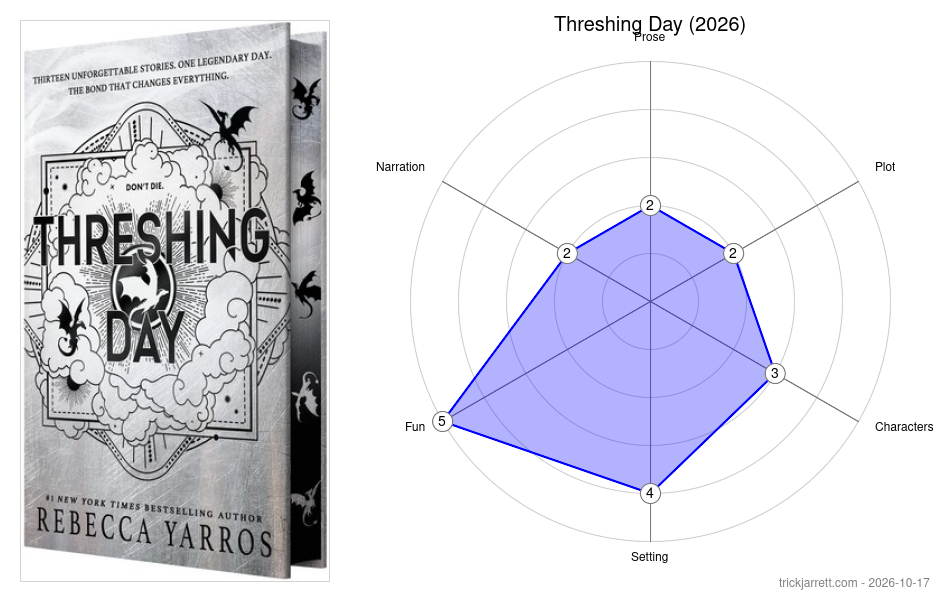
This is book 3.5 in the series and I continue to greatly enjoy the setting and the concept of the world, but this wasn't my favorite book. Rather than a full narrative novel, this is a collection of chapters each sharing a snapshot of other characters from the series from when they bonded their dragon.
While interesting to get a better insight into characters beyond Violet, the series' main character, this book left me feeling meh. The writing is fine. There is only a small amount of plot to the larger story, though it does contain some clear suggestions and insights into the larger plot.
I listened to the audiobook which utilizes a number of narrators across the chapters, and I found several of the chapters distractingly, well, bad. I won't spend too much time on this, just to say, I probably won't be listening to this book again.
And I don't know why, but there are large warnings of spoilers in the book which I also found weird - this is book 3.5 in the series, and while it does take place from before the start of the series up into it, I don't understand why someone reading this book would be surprised it had spoilers for books 1-3.

 |
|
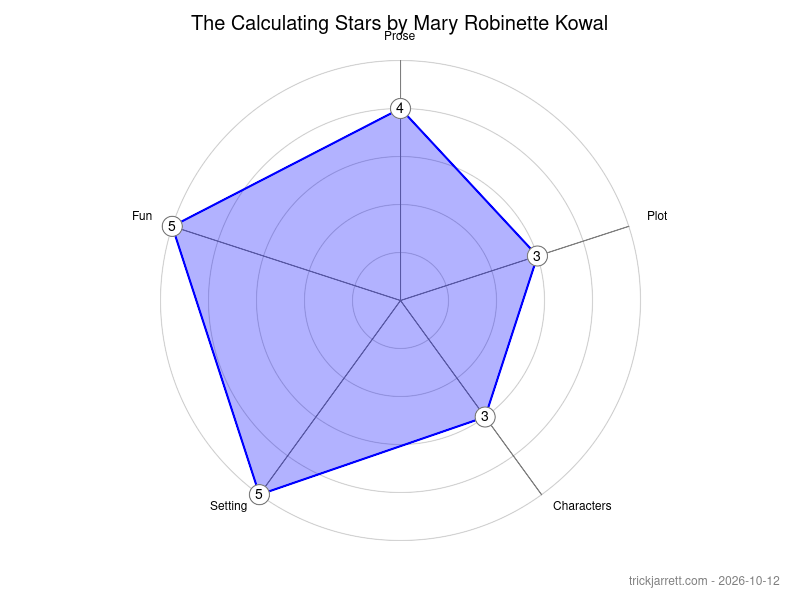
 The Calculating Stars - 4 out of 5 Stars
Finished Mary Robinette Kowal's 2018 The Calculating Stars last night and overall I enjoyed it! It wasn't perfect, but it had a lot that I liked.
Open the book with a global disaster movie, then combine Andy Weir's Project Hail Mary with elements of Margot Lee Shetterly's Hidden Figures, which inspired the movie about the calculators of early NASA, and you get the base recipe of this book.
The story opens with the question: How would the world react if Earth was hit by an extinction-level meteor in the 1950s, before we have even been to space yet at all?
We see a glimpse of things we're seeing today, such as global unification into an International Space Agency of sorts, as well as American politics, and even climate deniers, all make their presences known as part of the story.
We follow Elma York, a genius mathematician who was a WASP during World War II and her husband, Nathaniel, who both find themselves thrust into being part of the global effort to get to space to set about colonizing other planets. The story faces the times and explores: sexism, racism, antisemitism, and more, including Elma having to recognize her own internalized racism.
There are frequent time jumps in the story as we progress years from the inciting meteor impact to the world making it to space. Often these time jumps felt like Kowal, in the effort to simplify the story, would jump time and jump to events rather than lingering on the journey Elma was going through. The book could easily have been twice as long and I think in many ways I probably would have enjoyed it more had it been.
This book falls into the competency-porn genre, alongside Andy Weir's writings. The main character is a genius and spends the story convincing others that she can be an astronaut. She is the person who realizes the true danger of the meteor and that it poses an existential threat to humanity. She, multiple times, does complicated math that is critical to the space mission. She is a person who reading on a page I ask "why don't they just listen to her?" -- and that is the entire point. The sexism she faces, even as men around her acknowledge her as extraordinary, IS the point of the story.
I won't recount the full plot, though this leads me to my core criticisms of the book, which require spoilers for me to discuss.
Spoilers warning about the wrap up of the book:
There are two men in the space program who make clear to Elma that she won't be an astronette. One does so out of sexism, and one for a past event that Elma did which the other man takes personal.
The first man is the head of the space program. He and Elma had crossed paths during the war and it turns out Elma's father had been a General during the war. We don't get the details of what happened but the man had done something and she had reported him for it. An act he held an unbreakable anger towards her for and he swears she would never go to space because of it. Elma had turned to publicity and the press in her efforts to get women (and herself) accepted as astronauts. Her campaign and her fame grew, even being called "lady astronaut" by newspapers, Life magazine, and as a guest on Mr. Wizard. This publicity and public pressure overcame his ability to deny her the role, and it was almost that he was simply left behind. No concluding confrontation. No justice meted out, beyond the act of succeeding despite him.
The second of the men is a Neal Armstrong stand-in, and the conflict centers around sexism and the fact that Elma has anxiety attacks and is prescribed a drug, Miltown. She keeps the medication a secret afraid it will keep her from potentially going to space, giving him power over her for risk of exposing her. This, and his sexism, lead him to claim she can't be trusted on a mission in case she suffers an anxiety attack in a crucial moment. It's a looming threat for much of the book. And then, when he attempts to actually use this and block her from succeeding, after all the fear and focus that has been spent on it - we suddenly find no one around her cares. She doesn't outsmart him. It just... fails.
On the one hand - it's a good message, perhaps fitting as commentary on our own mental battles against imagined evils. But, for it to disappear so easily after having been one of the major concerns of going to space left me feeling unfulfilled and disappointed.
The majority of this has been my criticisms of the book despite my giving it a high rating. I really did enjoy it and came back eager to read each chapter. The story has a lot of charm and I will check out its sequel in the future.
Giving both Characters and Plot 3's feels harsh but its where I land. The vast majority of the characters in the story are 5's, but there are some real stinkers here that I struggled with. A few key moments felt like the characters were acting purely as Kowal needed and not because of realistic and believable narrative. Looking past those though, there are several characters I adore including Elma and her core cadre.
The plot being the other mid-mark is explained with both my above spoiler laden criticisms but also because of the time jumps I mention above. There were several times I wished to see and understand more of the journey. As I think on it more, I think the criticisms I hold to this book heavily come down to what isn't there. Perhaps the editors took too much away? Who's to say.
But if my criticism of a good book is I wanted more, then it's a sign of a great book.

 |
|
The House of the Vestals by Steven Saylor

I've read this series since high school. I picked this one back up randomly and it was lovely to return to the world of Gordianus the Finder. This wasn't the one I meant to pick up, as this one is a series of short stories, but it was still a fun and quick read.
|
Saturday Shopping
The wife and I went out to visit a few local businesses. One of which was a "Retro Emporium" which has lots of nostalgic games and toys. We primarily go there these days to look through their vinyls, but while there I spotted two D&D items they had which I didn't own for my collection.

So, obviously, I picked them up. They also had an NES system running Duck Hunt and it is so nostalgic for me to use. Also, I've still got it. Fastest gun this side of the Mississippi.
Our other stop on this outing was our local library as I had requested a book: Strike, by Sarah E. Bond. I've been meaning to pick it up but I couldn't find it for a DRM free ebook, so rather than purchase the Kindle version I opted to borrow the physical copy. Feels good to support our local library system.
It was pleasantly busy with people, I'm sure some were there escaping the warmer weather, but I hadn't been inside the local branch in some time and I was concerned it was going to be empty
|
Finished Parade of Horribles
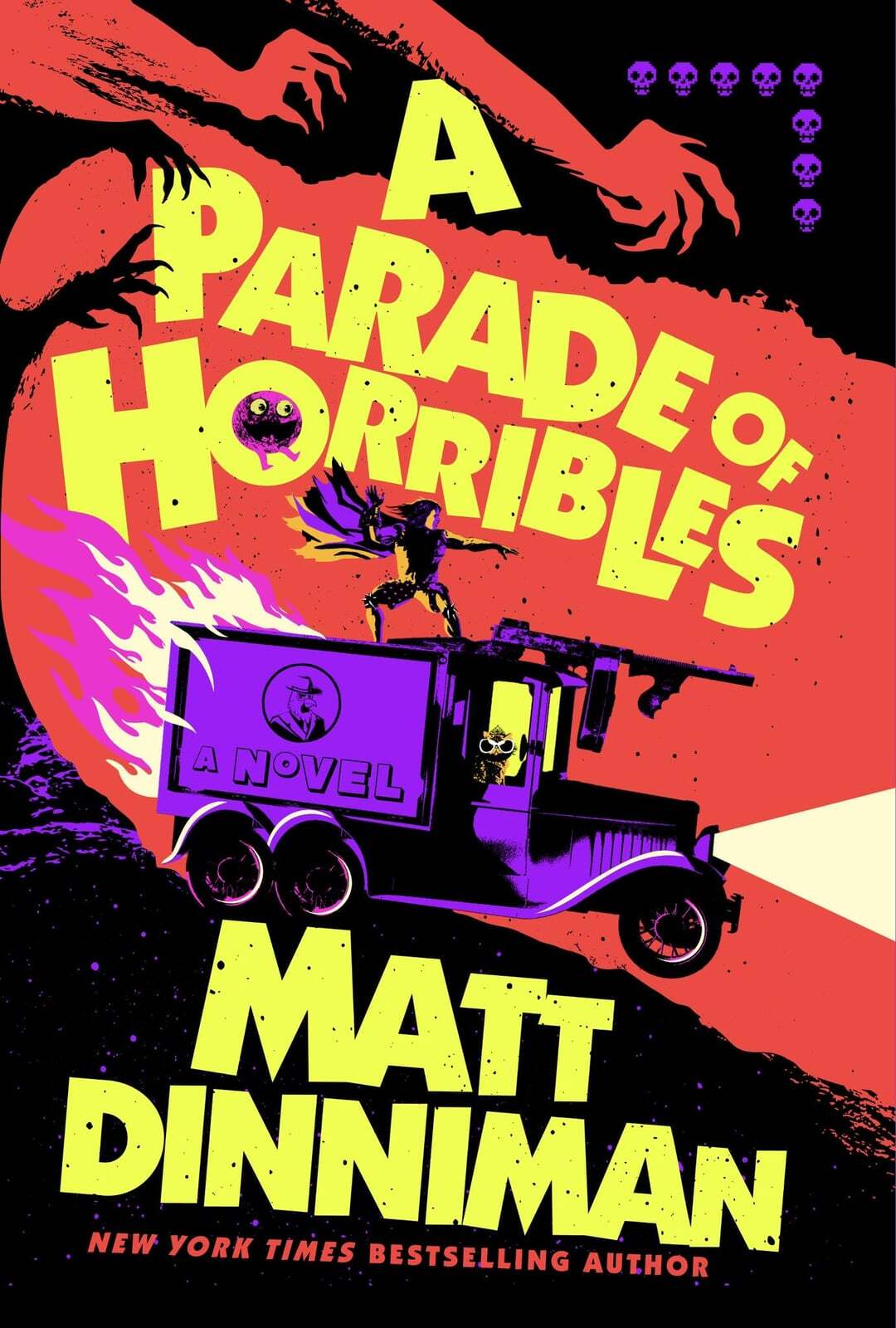
Just finished Parade of Horribles, book 8 of Dungeon Crawler Carl. It took a little while for me to get into this one, the series is understandably getting more dire and less "fun."
That said, I definitely came around on it by the end of the story and I'm immediately beginning to re-listen to the audiobook to see what I discover now that I know how this story ends.
|
Just quietly reading
Last night we had a nine-hour power outage. While my laptop had power, I ended up spending more of the evening reading on my e-reader. It was nice. I am so often distracted by a device. Even as I write this, I have an audiobook playing on my phone.
The thing they are saying about rotting brains and shortening attention span, I definitely feel. So it felt nice to read the book and just focus on it. I need to do that more and push back at the always-on television or audio on my phone.
|
"How I Read 44 Books Last Year"
Very solid advice:
My #1 trick is momentum: I try to read fifteen pages or more every day.
I developed this to avoid a rut I often fell into: I’d read slowly, put the book down for days, forget the plot or why I was interested in it, and abandon the book.
Reading a few pages every day keeps the story fresh and keeps me inching forward.
|
On Tyranny
A short read which should really be required reading for the world right now.
Here are a few passages I highlighted from the book.
These two excepts came from the Prologue of the book:
Since the American colonies declared their independence from a British monarchy that the Founders deemed "tyrannical," European history has seen three major democratic moments: after the First World War in 1918, after the Second World War in 1945, and after the end of communism in 1989.
Fascists rejected reason in the name of will, denying objective truth in favor of a glorious myth articulated by leaders who claimed to give voice to the people.
From Chapter 1 "Do not obey in advance":
Crucially, people who were not Nazis looked on with interest and amusement.
From Chapter 3 "Beware the one-party state":
The American abolitionist Wendell Phillips did in fact say that "eternal vigilance is the price of liberty." He added that "the manna of popular liberty must be gathered each day or it is rotten."
From Chapter 5 "Remember professional ethics":
If lawyers had followed the norm of no execution without trial, if doctors had accepted the rule of no surgery without consent, if businessmen had endorsed the prohibition of slavery, if bureaucrats had refused to handle paperwork involving murder, then the Nazi regime would have been much harder pressed to carry out the atrocities by which we remember it.
This section is largely reminding that the Nazi atrocities relied on professionals bending to the evil acts of others to either support directly or at least not impede. The government machine we see happening in DC is the system working as it resists the changes the government is undergoing.
From Chapter 7 "Be reflective if you must be armed":
Yet we make a great mistake if we imagine that the Soviet NKVD or the Nazi SS acted without support. Without the assistance of regular police forces, and sometimes regular soldiers, they could not have killed on such a large scale.
This section largely says "look, if you're going to get a gun, don't lose perspective." But again, similar to the above, it's a reminder that secret police rely on the support of local law enforcement. Which makes the local PD and Sheriff departments refusal to help with ICE etc. are critical resistance elements.
Chapter 10 "Believe in truth":
Post-truth is pre-fascism.
Chapter 14 "Establish a private life":
What the great political thinker Hannah Arendt meant by totalitarianism was not an all-powerful state, but the erasure of the difference between private and public life.
Chapter 17 "Listen for dangerous words":
The way to destroy all rules, he explained, was to focus on the idea of the exception. A Nazi leader outmaneuvers his opponents by manufacturing a general conviction that the present moment is exceptional, and then transforming that state of exception into a permanent emergency. Citizens then trade real freedom for fake safety.
|
The Wager - DNF
I finally gave in on trying to read The Wager. I think it is a me-thing and not a commentary on the book. It's an interesting fictionalized telling of a historical event based on journals and other historic records.

I am about 45% of the way through and I just... lost motivation to keep going on it. It's well reviewed and many people enjoy it, so it's not a universal experience with the book, but I just have decided to, well, abandon ship.
|
"William F. Buckley's Bill Never Came Due"
I don't intend to read the book, but I found this summary and review to be a fantastic read.
Perhaps the highest praise I can offer a book that took 27 years to complete and runs over 1,000 pages is that I can see why, and that it doesn't feel like it. Sam Tanenhaus's extremely long and anxiously awaited biography of the man who founded National Review, and is often regarded as the architect of modern American conservatism, arrived with a resounding thud on my doorstep. There is no way that a book the size of Buckley: The Life and The Revolution that Changed America could arrive quietly. It is, in many ways, a remarkable accomplishment: exhaustive but not tiring, serious yet lively, both affectionate and suspicious. It is almost dizzyingly populated with recognizable characters—the result of Buckley's famed and enormous social influence—which offers regular satisfaction both to readers who like knowing what Sylvia Plath thought of the Buckley family home, and ones who yearn to learn more about cranky Viennese ex-Leninists. Most of all, Buckley is very clearly the result of slow thinking and methodical research, which makes it precisely the sort of work that its subject could never produce.
|
"The Best Presidential Biographies"
A collection of ratings and reviews of Presidential biographies for (nearly) every US President.
From the author's about page:
Given my fascination with the presidency and love of great writing, in 2010 I began collecting the best biographies of each of the presidents. In late 2012 I embarked on a quest to read them all – beginning with George Washington.
This site was initially created to log my journey and organize my thoughts. But 260 presidential biographies later it has evolved into something a bit larger…
I finished my first pass through the presidents on Presidents’ Day 2019 – after six fascinating years. Now I’m reading presidential biographies from my follow-up list as well as great biographies of non-presidents.
Describing the rating methodology:
Ratings are on a scale of 0 to 5 stars, with equal weight given to my subjective assessment of: (1) how enjoyable the biography was to read and (2) the biography’s historical value (including comprehensive coverage and critical analysis of its subject).
|
Ardent Violet and the Infinite Eye (2024) - 4.5/5 Space Mechs
I've got to share how much I enjoy the second book in the Starmetal Symphony series by my friend Alex White. It's a great follow up in the series, filled with twists and turns, as well as dramatic and touching moments. Just a fun and enjoyable ride filled with memorable characters.
Just wait until you meet Scent of Rot. 🦀
|
"It’s official: Research has found that libraries make everything better."
Far from an earthshaking study in its breadth and depth, but it's good to see and hopefully it will drive some greater awareness and investment.
Science has backed up what many of us have long been saying: the library rocks. A study from the New York Public Library surveyed 1,974 users on how the library makes them feel and how it affects their lives, and the results are overwhelmingly positive.
The researchers' analysis (which used positive psychology's PERMA model, if that means anything to you) discovered that libraries are good for people, their well-being, and their communities. Not only that, but the positive societal impacts are more pronounced in lower-income communities, even more reason to make sure we're funding and supporting libraries. Don't let the ghosts of Reagan and Thatcher tell you otherwise, government can help people!
|
"The Ministry of Time" (2024) - 3.5 of 5 little cats
From the book listing:
A BOY MEETS A GIRL.
THE PAST MEETS THE FUTURE.
A FINGER MEETS A TRIGGER.
THE BEGINNING MEETS THE END.
ENGLAND IS FOREVER.
ENGLAND MUST FALL.
There are several ways to tell a story.
I finally finished this book, taking my sweet time doing so (I blame Balatro for that at least some, but not entirely.) Truth is that the story did not grab me until the final act. There, it swept me in, and I quickly tore through the final pages.
Looking back, I had found a handful of turns of phrase which I highlighted. Most are spoiler-laden so I won't share them here, but here are a few choices ones.
In a discussion about religion:
Belief has very little to do with rationale. Why demand a map for uncharted territory?
Next is a line that I thought this was an interesting social observation.
Most friendship quartets don't function in squares but in lines
And lastly this line:
Most things don't happen. Mostly the universe is parking space
|
The Bookshop: A History of the American Bookstore (2024) - DNF Review
I made it roughly halfway through the book before calling it quits. I found the general segments interesting, but I found it tiresome for the continual jumping around which is necessary for the sweeping history of the bookstore and publishing industry in America.
There was a lot of interesting insights in the book, interspersed with snippets about independent bookstores which sometimes played a part in larger historical narratives the author tells. But there is not chronology to fall back upon as the book often jumps forward and backwards through time between chapters.
I think a lot of people will enjoy the book, but I just ran out of steam on it and am ready to move onto a new book.
|
Training Ground by Martin Dugard
A few months ago I saw a video on YouTube which was examining the inherent geographical advantages that the USA has. And, from what it covered, it talked about how much of what was once Mexico's most arable and verdant land was lost to the US during the Mexican-American war.
Now, I know about the war in the very broad strokes, but I didn't really have a strong sense of it. So, I went looking for some books to read on the topic and eventually landed on Training Ground by Dugard, as I thought the framing of the war as also a place that many of the notable names from the Civil War was interesting.
Here's the blurb on Amazon:
For four years during the Civil War, Generals Grant and Lee clashed as bitter enemies in a war that bloodied and scorched the American landscape. Yet in an earlier time, they had worn the same uniform and fought together.
In The Training Ground, acclaimed historian Martin Dugard presents the saga of how, two decades before the Civil War, a group of West Point graduates—including Robert E. Lee, Ulysses S. Grant, Jefferson Davis, Stonewall Jackson, and William Tecumseh Sherman—fought together as brothers. Drawing on a range of primary sources and original research, Dugard paints a gripping narrative of the Mexican War, which eventually almost doubled the size of the United States.
The Training Ground vividly takes us into the thick brush of Palo Alto, where a musket ball narrowly misses Grant but kills a soldier standing near him; through the mountains and ravines of Cerro Gordo, as Lee searches frantically for a secret route into the Mexican army's seemingly invincible position; to Monterrey, as future enemies Davis and Grant ride together into battle; down the California coast, where war-hungry Sherman seeks blood and vengeance. And we are there as the young troops mount the final heroic—and deadly—assault on Mexico City.
So, for the past few weeks I've been working through it. The truth is, I am not a big war history buff and I found the book hard to get through for that reason. It's not just four biographies, it is an overview of the war which zooms in on portions relating to the four of them, but still maintaining the overall narrative of the war. Today, on my flight to Las Vegas for work, I finally finished it.

(The above is from Wikipedia, not the book. Including it for the reader's benefit.)
Overall, if you're like me and wanting to learn about the Mexican-American war, or its connections to the Civil War, I recommend this book. But I don't think I recommend it as a general book for most people.
I did export the segments I highlighted from the book, and will share them here as well as giving some small notes after each:
"They may shout and hurrah, and dance around the bonfires that will be lighted, the cannon that will roar in honor of some field of human butchery; but to what end? Is not life miserable enough, comes not death soon enough, without resort to the hideous energy of war? People of the United States! Your rulers are precipitating you into a fathomless abyss of crime and calamity! Why sleep you thoughtless on its verge, as though this was not your business, or murder could be hid from the sight of God by a few flimsy rags called banners? Awake and arrest the work of butchery ere it shall be too late to preserve your souls from the guilt of wholesale slaughter! Hold meetings! Speak out! Act!"
This comes from a segment which described the anti-war efforts against this war. I found the verbiage and tone very interesting to see, with some echoings to today.
"Live your life that the fear of death can never enter your heart," said Tecumseh.
One thing the book highlights is that some names I know historical figures by were modified because of their enrollment in West Point. "William" Tecumseh Sherman was not born William. It was added to his name by his father when he was submitted for admittance to West Point.
Ulysses S. Grant had no S. initial until he arrived at the school due to some clerical error. And because his name would be listed as U. S. Grant, he got nicknamed (Uncle) Sam Grant, which he chose to just go by and not fight.
But, I found this quote from Sherman interesting, while not revolutionary to hear in this modern era it speaks a great deal to his mindset and that which became evident in the Civil War.
The result was an appalling number of deaths. Unmarked graves soon lined the San Juan. Regimental bands so often played a death march for funerals that Camargo's mockingbirds learned to mimic the refrain.
I found this just so dark. Again, I've heard this concept before of birds learning songs from humans, but under the framing of this war it struck me enough that I highlighted it while reading.
President Polk's Democratic Party had a long-standing distrust of the armed forces, believing that the nation had little need for a standing army. Volunteers like Davis were his ideal soldiers. "It has never been our policy to maintain large standing armies in time of peace," Polk had declared before the war began. "They are contrary to the genius of our free institutions, would impose heavy burdens on the people and be dangerous to public liberty. Our reliance for protection and defense on the land must be mainly on our citizen soldiers, who will be ever ready, as they have been ever ready in times past, to rush with alacrity, at the call of their country, to her defense."
Oh how far this country has come, and learned. The book points out that the Mexican-American war was basically the first war for the US after the war of 1812. And it jumped out to me how different the political landscape was where they questioned even needing a standing army at all. Obviously, Polk here is meaning that the country would rely more on the militias, rather than the standing army. It's like saying that cities shouldn't have paid fire departments and should rely entirely on volunteer fire departments. Or, I suppose, perhaps it is even more about state vs national in the structure, but, regardless - the correct decision won out.
Polk's greatest dilemma over Taylor's armistice, however, lay not with the opinions of the British or the French, and certainly not with that of the Mexicans. It was the American people whom he feared most. The problem had its roots in democracy and a politician's need to be elected by the people before being allowed to serve. Americans had historically been an easily malleable, highly illiterate, and ill-informed mass of voters. But that was changing, and quickly. Technological advances in papermaking and the invention of the steam printing press (which printed well over 1,000 pages per hour, as opposed to the 240 of the Gutenberg-style manual press) had made newspapers affordable and more easily mass-produced beginning in the 1830s. Once only for the well-off, papers sprang up all around the country; New York alone had eleven dailies, a quick source of news and opinion available for as little as a penny a day.
Another interesting insight outside of the war; that the changing face of the populace thanks to the industrial revolution's innovation of the printing press threatened to interfere with the politics behind and around the war. Another echoing moment for today and the land of social media, etc. Obviously the question around algorithms etc., is inherently different at a base level, but still, I see interesting parallels still today - 200 years later.
Scott's invasion of Veracruz was the largest-ever landing of American troops on foreign soil and would not be surpassed until June 6, 1944 — D-day.
This passage jumped out at me. It lasted nearly 100 years.
Grant's job during the three-month delay in Puebla was to ride out with empty wagons and purchase produce and goods from local farmers. As a result, he often returned looking dirty and unkempt, his uniform unbuttoned for comfort. The date has been lost to history, but sometime during this period, Lee paid a visit to Garland's command and remonstrated Grant for his lack of spit and polish. It was the first time the two men ever met, and the wording was harsh enough that Grant would remember it for the rest of his life — and would remind Lee of it again when next they met on a Palm Sunday far in the future.
A bit poetic here.
By 4:00 a.m., Mexico City's authorities had sent a delegation to Scott, requesting terms of surrender. As the sun rose over the capital the following morning, the American flag was raised over Mexico's National Palace. Scott slept there that night, guarded by a squad of U.S. Marines, in what was also known as the Halls of Montezuma.
It's one of the few lines I know from the Marine Corp. anthem, and I had forgotten it was a direct reference to the Mexican-American war.
Homesick for Julia and their growing family, he abruptly resigned his commission in 1854 and returned home. Rumors that drunkenness was the cause have been greatly exaggerated, as Grant was known for his inability to drink more than a few sips of alcohol owing to his light weight and diminutive size. He struggled to find a new profession and soon failed at a number of business ventures that included farming, tanning, and bill collecting. When the Civil War began, Grant was commissioned as a colonel in the Illinois militia. Within three years he had risen to become general-in-chief of all U.S. armies. Following the war, he returned to civilian life. Grant successfully ran for president in 1868 and served two terms. He died on July 23, 1885, shortly after completing his memoirs, which were edited by Mark Twain.
The Epilogue gave a post-war summation of each of Grant, Lee, Sherman and Davis; this passage from Grant was interesting to me. I had forgotten that Mark Twain edited Grant's autobiography, and also I didn't know about his non-war life and how he had attempted a few businesses before being called back to war and rising through the ranks to Commander-in-Chief.
And that's it. As I said, overall I enjoyed the book and it accomplished what I set out to do, but it didn't floor me such that I am going to urge everyone to read it.
|
"The woman who revolutionized the fantasy genre is finally getting her due"
Think of your favorite fantasy or science fiction novel. You'll know the author and title, of course. But can you think of its editor or publisher?
In publishing, the people who work behind the scenes rarely get their due. But on Oct. 1, 2024, at least, one industry pioneer got the limelight. On that day, PBS aired "Judy-Lynn del Rey: The Galaxy Gal," the first episode of its new documentary series "Renegades," which highlights little-known historical figures with disabilities.
A woman with dwarfism, Judy-Lynn del Rey was best known for founding Del Rey Books, a science fiction and fantasy imprint that turned fantasy in particular into a major publishing category.
|
Artemis by Andy Weir - 3/5 Oxygen Tanks
So I finally read Andy Weir's 2017 novel, Artemis. It follows Jazz, who lives on the moon colony with the book's title, Artemis. I am a big fan of the near-future science fiction genre and I think Weir delivers on it better than most, however I struggle with the plot of Artemis a few times along the way. There is, to me, a gaping "feel good" plot hole with the resolution of the story and it really soured the book for me.
Interestingly, this is a book I thought I had started previously and was immensely turned off from but when I came back to it recently, I had zero memory of any of it and went along for the ride.
It's a fine read and it's an interesting plot that is only doable through this near-future sci-fi genre, but yeah - bring along a healthy suspension of disbelief and just go for the ride.
|
Good morning from SeaTac airport
I got up even earlier than I had planned because I was within an hour of my alarm and at that point my body won't let me go back to sleep. So here I am, mildly caffeinated, and sitting at a power outlet for a few hours before my flight.
On Psychology & a Rewrite
Last night, as I was tweaking Glowbug code, I began thinking I might just need to start new on the backend. The current system is five years old at this point and while it is still quite serviceable, there are also quality of life things I need to work on which I keep putting off because I just don't want to wade into the code.
The irony, of course, being that a complete rewrite would be magnitudes more work.
Brains are funny that way.
Flight Entertainment
As mentioned, I am at the airport with a day of travel ahead of me. I've loaded up on entertainment so expect some reviews once I land:
Movies & TV
- MAX's Chernobyl - I didn't watch it when it came out, but I've finally relented and have it downloaded
- Dropout's recent episodes - I watch most Dropout shows and I'm behind from this past week
Podcast
- Worlds Beyond Number - I listen to this amazing podcast on and off, mostly off. But I've got ten episodes downloaded in case I decide to binge it while I fly.
Books
Too many. I'll list some, but I checked last night and I carry nearly 3 gigs of ebooks on my reader.
- The Shortest History of Economics by Andrew Leigh [currently reading and enjoying]
- How to Clone a Mammoth by Beth Shapiro
- Reality is Not What it Seems by Carlo Rovelli
- The Rise and Fall of the Dinosaurs by Steve Brusatte
- This Strange Eventful History by Claire Messud
- Contagious: Why Things Catch On by Jonah Berger
- A Beautifully Foolish Endeavor by Hank Green
- The Light Ages: The Surprising Story of Medieval Science by Seb Falk
- Bear: Myth, Animal, Icon by Wolf Storl
Really, the list goes on. I am an eclectic reader and I have an addiction to acquiring ebooks for my virtual library.
And now I must go in search of more caffeine.
|
The Lies of Locke Lamora - 4/5 Stars
I have been wanting to read this book for a while. In fact I tried a few years ago but bounced off it. Listening to it, via the Libby audiobook app, finally got me through the book. The style of the book takes some getting used to, it jumps back and forward in time which was part of what was offputting for me, but once I got settled I found it quite enjoyable.
There is a character, "Chains" (and whatever you are imagining for this character, I guarantee you are wrong.) I quite like this character and I kept imagining them portrayed by John Noble back in the early 2000s, when he played Denethor in the LOTR movies.
I'm onto the second book in this series, here's hoping it keeps my attention!
|
Scarcity Brain - 3 out of 5 hunger pangs
I just finished this audiobook. It fits neatly into my 'infotainment' category. There are some interesting ideas here, but it isn't a book I'll rush out to tell my friends to read.
It starts out strong, delving into the history and modern business of slot machines and how they shape and are built around playing the human brain against its person, something the author calls the scarcity loop. Playing on that mechanism in our brain to drive the further capitalism.
Overall I found this the most interesting portion of the book, and everything afterwards was something I could have personally skipped. There were interesting insights and stories, but nothing that made me go 'oh wow!'
|
Revising my 2024 Reading Goal
Coming into 2024 I resolved to read more books. I do read, and probably more than the majority of people, but nowhere near as much as I want to. I enjoy reading. But it is a constant battle against the Internet. So, making it a priority for this year is a thing I want to do.
I came in with the ambitious goal of reading 50 books this year, however I realized that this doesn't incentivize me the way I want. I've come to enjoy reading a lot more once I realized I can stop reading books when they stop being enjoyable or being worth the effort. And by making my goal 50 books, that pushes me not to quit books and thus makes picking up a book to read much more important.
First was "Our Oldest Companions" by Pat Shipman, which is a book looking at the history of humans and dogs. An interesting read, but I found it plodding at points and ultimately fell off. I had thought the book would be much more behavioral, and it does touch on that, but it is very focused on the transition point of wolves to dogs, and that as it turns out is not as interesting for me.
Second was a fiction novel which I'll admit I picked off of BookTok. "People from my Neighborhood" by Hiromi Kawakami. The pitch didn't reveal the true nature of the book, which I am glad for, despite it not being my cup of tea.
So, given that I'm in the third week of the year and I have abandoned two books already, it's clear that I need to change.
The current goal means I have to pick books which are ones I "have" to finish. And that isn't feasible. I need fluidity and flexibility.
Given this, I'm revising my goal. Rather than books, my goal is pages. If I arbitrarily set an average book length of 300 pages, then that translates 50 books into 15,000 pages this year. I tracked how far I got into each of the abandoned books, as well as the book I already finished. And it puts me at around 525 pages so far this year, which is a little behind pace for what I need for 15,000 pages. But is directionally where I want to be and so I feel good about it.
I've since finally dipped my toe in to Terry Pratchett's Discworld as I'm now reading Guards! Guards! and quite enjoying it. Additionally, I am working through an an audiobook called Scarcity Brain by Michael Easter. It's definitely infotainment, but I've taken a few interesting tidbits away from it. I'm glad I'm taking it as an audiobook, I think if I had read it as a book I would have bounced off at a few portions.
|
There is No Antimimetics Division by qntm - 3.5 / 5 Antimemes

There is No Antimimetics Division by qntm
Blurb from its Amazon listing:
An antimeme is an idea with self-censoring properties; an idea which, by its intrinsic nature, discourages or prevents people from spreading it.
Antimemes are real. Think of any piece of information which you wouldn't share with anybody, like passwords, taboos and dirty secrets. Or any piece of information which would be difficult to share even if you tried: complex equations, very boring passages of text, large blocks of random numbers, and dreams...
But anomalous antimemes are another matter entirely. How do you contain something you can't record or remember? How do you fight a war against an enemy with effortless, perfect camouflage, when you can never even know that you're at war?
Welcome to the Antimemetics Division.
No, this is not your first day.
Ironically, I can't remember how this book came across my attention. Maybe it was a mention by a BookToker, or maybe another social media post, but the premise grabbed my attention as it is about something which has long fascinated me, playing with memory.
The book is not normally in the realm I would read. It is a bit of a horror novel, with lots of gore and body horror described, but I came to think of the horror aspect of the novel as a bit more art house / new age. The base concept of the novel is so out there and theoretical that it made it easy for me to remove myself from the action and partition it off in my mind - I'm not the one enduring the horror, I'm the observer.
The premise of the novel is hard to summarize, but I think the way I will approach it is this: It is a novel in the vein of the online "SCP" genre. SCP is an a meta genre of fiction writing, where many different individuals contribute to a corpus of sci-fi / horror / supernatural stories with a very dark and, often, experimental tone or styles of writing.
This book is very much all of that. It is weird. It is hard to read sometimes as your brain grapples with shifts in voice or perspective, etc. But it was an interesting ride. Like sitting in a bumper car as it traverses through an art house. You're a passenger with no control of the story, observing what is around you, jarred and bumped and sometimes confused.
As the rating says - largely, I liked it. I have no desire to read it again, even if I would get more out of it with a better understanding for its goings on. Worth noting, it is a quick read. And while I spread it out over a few days, my reader tells me I spent just three hours reading it in total.
This is my first book of 2024. I'm setting a goal of reading 50 books this year, and while I started this one last year, I feel it is fair to count it to this book total as I could have as easily read it all this morning had I decided I wanted to.
|

